





Table of contents
The Executive Briefing: Navigating the Shift to Autonomy

Executive Summary: The Great Decoupling of Growth and Headcount
For most of modern business history, the formula for scaling has been brutally simple and brutally expensive: to do more, you needed more. More staff. More software seats. More office space. More overhead. Growth and headcount were chained together like prisoners in a chain gang—you could not move one without dragging the other along behind it.
The “Automation Revolution” of the 2010s promised to break those chains. Tools like Zapier, Make, and traditional Robotic Process Automation (RPA) platforms such as UiPath and Blue Prism gave operations teams their first real taste of digital leverage. But these tools, for all their utility, only solved the easy half of the problem. They built rigid digital pipes that could move data from System A to System B—but they could not think about the data they were moving. Hand them an unexpected input, an ambiguous request, or a customer who did not follow the script, and they ground to a halt.
Today, we are witnessing what we at Sharp Instincts call the Great Decoupling. Through Agentic Automation, forward-thinking enterprises are scaling their output exponentially while keeping their human headcount focused on the work that actually matters: strategy, creativity, relationship-building, and judgement. This is not “faster” automation. It is not “smarter” RPA. It is the deployment of autonomous digital coworkers—agents capable of reasoning, planning, executing, and self-correcting against complex business goals with minimal human oversight.
This guide is the most comprehensive resource available on what agentic automation actually is, how it works under the hood, where it delivers the highest return on investment, and—critically—how to deploy it responsibly inside an Australian business operating under the Privacy Act, the AI Ethics Framework, and the realities of a competitive global economy. Read it once to get the lay of the land. Read it twice and you will start mapping it onto your own operations almost involuntarily.

Part 1: The Evolution of Intelligence – From “Rules” to “Reasoning”
A Brief History of Business Automation
Understanding where agentic automation fits requires understanding what came before it. Business automation has moved through three distinct eras, and the current shift is at least as significant as the previous two combined.
- Era 1 – Mechanical Automation (1900s–1980s): Conveyor belts, mainframes, and the first electronic spreadsheets replaced manual labour. Each tool did exactly one thing, very fast, with no understanding of context.
- Era 2 – Workflow Automation (1990s–2010s): Software like SAP, Salesforce, and later Zapier let businesses chain digital actions together. Data flowed between systems, but every rule had to be hand-coded by a human and every exception broke the chain.
- Era 3 – Agentic Automation (2023–present): For the first time, software can be given an outcome rather than a script. The system itself decides which actions to take, in which order, and adapts when something goes wrong.

The Failure of Traditional Automation
Traditional automation is deterministic. It follows a strict script: If Event A happens, do Action B. This works perfectly for simple, repetitive tasks like “when an email arrives with the subject ‘Invoice’, save the attachment to Dropbox.”
But business is rarely that simple. What happens when the attachment is a blurry photo of a receipt rather than a structured PDF? What happens when the email is a complex complaint that requires empathy, nuance, and a refund calculation that depends on three different policy clauses? Traditional automation breaks. It either silently fails, escalates to an overflowing human queue, or—worse—takes the wrong action confidently and at scale.
Over time, this creates what we call automation debt: an ever-growing pile of half-working scripts, edge cases, and “human exception” workflows that consume more management attention than they save. Every brittle Zap is a future maintenance ticket. Every undocumented if-statement is a landmine waiting for a junior staff member to step on.

The Rise of the Agentic Paradigm
Agentic Automation is fundamentally different. It is stochastic and goal-oriented. Rather than handing the system a list of steps, you hand it a goal and a toolkit, and the system itself works out how to get from the start state to the desired outcome—adjusting in real time when reality deviates from the plan.
A modern enterprise agent is built from four interlocking components, each of which has matured rapidly in the past 24 months:
- The Brain (LLM): Large Language Models such as Claude Sonnet 4.5, GPT-4o, Gemini 1.5 Pro, or open-weights models like Llama 3.3 process natural language, weigh trade-offs, and produce reasoning traces.
- The Planning Layer: The agent breaks the goal into sub-tasks, sequences them sensibly, evaluates intermediate progress, and self-corrects when it hits an obstacle. Modern frameworks implement this with explicit “Reflection,” “Tree-of-Thoughts,” and “ReAct” patterns.
- The Memory Layer: Short-term context (the current task) and long-term memory (your business knowledge base) keep the agent grounded in your organisation’s reality, not generic internet data.The Tools (Action Layer): The agent is granted scoped access to your APIs, CRMs (Salesforce, HubSpot), ERPs (Xero, NetSuite, MYOB), document stores (SharePoint, Google Drive), and communication channels (Slack, Microsoft Teams, email).
- Expert Insight: At Sharp Instincts, we draw a hard line between “chatbots” and “agents.” A chatbot talks. An agent acts. An agent has agency—the delegated authority to make decisions and trigger real-world effects within carefully defined guardrails to achieve a specific business outcome. That distinction is not academic; it is the difference between a novelty FAQ widget and a genuine member of your operations team.
Part 2: The Multi-Agent Orchestration Stack
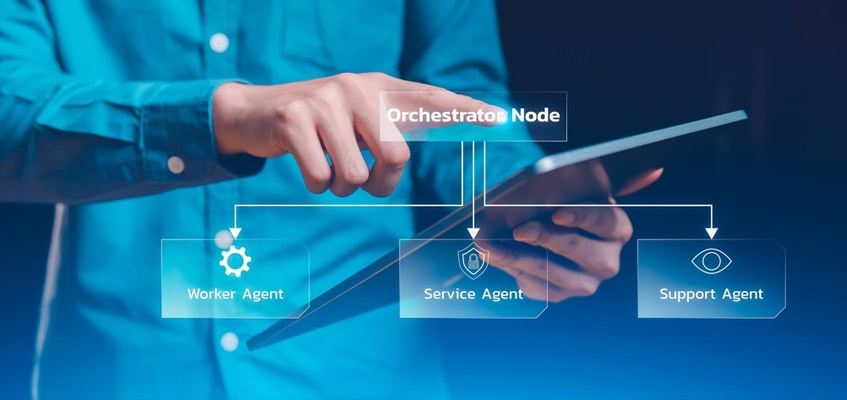
To build enterprise-grade agents that survive contact with real-world complexity, Sharp Instincts deploys a sophisticated technical architecture that goes far beyond a single API call to a single LLM. We architect Multi-Agent Systems (MAS)—structured teams of specialised agents that collaborate the way a high-functioning human team does.
1. Agent Roles and Specialisation
Just as you would not ask your accountant to write your marketing copy or your designer to negotiate a supplier contract, we do not build a single “God Agent” expected to handle everything. Mono-agents fail at scale because their context windows fill with irrelevant instructions and their reasoning becomes muddled. Instead, we build specialised crews using frameworks like CrewAI, LangGraph, and Microsoft AutoGen.
A typical operational crew includes:
- The Researcher Agent: Specialised in browsing the web, scraping data, and synthesising information from multiple sources into structured briefs.
- The Writer/Analyst Agent: Specialised in transforming raw data into structured reports, customer-ready emails, or board-level summaries.
- The Manager/Orchestrator Agent: The “project manager” that breaks down high-level goals into distinct tasks, allocates them to the relevant specialist, and examines their output for quality control before passing it on to humans.
- The Critic Agent: A specialised quality-assurance function that audits the work of other agents, finds mistakes, and either approves the outcome or asks a modification.
This separation of responsibilities makes the system substantially more accurate, far easier to debug, and allows you to change particular agents in and out when better models become available – without rebuilding the whole system.
2. Retrieval-Augmented Generation (RAG) and Long-Term Memory
The number-one reason businesses hesitate to deploy AI is fear of “hallucination”—the model confidently inventing facts. We engineer that risk almost entirely out of our systems through Advanced RAG (Retrieval-Augmented Generation).
- Vector Databases: We index your company’s internal knowledge—policies, contracts, PDFs, internal wikis, past email threads, and structured database records—into specialised systems like Pinecone, Weaviate, or Milvus. Documents are converted into mathematical embeddings that capture meaning, not just keywords.
- Hybrid Search: Modern RAG combines semantic vector search with traditional keyword (BM25) search, then re-ranks results to surface the most relevant context for the specific question.
- Grounding: Before an agent answers a question or takes an action, it must first retrieve the relevant facts from your private database. The agent is explicitly forbidden from making up information; it can only reason within the context it has been given.
- Citations by Default: Every output includes pointers back to the source documents the agent used, so a human reviewer can verify the chain of reasoning in seconds rather than minutes.
The result is an AI that knows your business as intimately as a five-year veteran—and never invents a policy that does not exist.
3. Tool-Use and Function Calling
Our agents are tool-augmented. They do not guess what is in your inventory; they execute a specific Python function or API call to query your warehouse database in real time. They do not speculate about a customer’s lifetime value; they call your CRM and read it directly. This grounding in live data is what separates a useful agent from a glorified chatbot.
We build each tool with three layers of safety:
- Scoped permissions: an agent can only call the specific tools it has been authorised to use, enforced at the orchestration layer rather than relying on the model to obey instructions.
- Parameter validation: every tool call is checked against a strict schema before it runs, catching nonsensical inputs before they reach production systems.
- Action logging: every tool invocation is recorded for audit, replay, and debugging, with full input and output fidelity.
4. Model Orchestration & Cost Engineering
Not every job needs the most expensive model on the market. A basic categorisation step might do just fine on a small, rapid model that costs fractions of a cent. A vital contract analysis deserves the flagship reasoning model. Our orchestration layer dynamically routes each step to the right model, balancing intelligence, latency, and cost on a per-request basis.
This is one of the highest-leverage optimisations available—our clients routinely see token costs drop by 60–80% in the first three months of operation without any loss of output quality. Cost engineering is not an afterthought; it is a first-class part of how we design every workflow.

Part 3: Industry Use-Case Deep Dives
To demonstrate the real-world power of agentic automation, we have mapped detailed “before and after” scenarios across the key Australian business sectors we serve. Each is drawn from active client engagements or close analogues, with the numbers anonymised but representative.
I. Professional Services and Legal
- The Challenge: Junior associates and paralegals spend up to 40% of their billable time on document discovery, contract review, and summarising case law—work that is essential, unrewarding, and difficult to scale without proportional hiring.
- The Agentic Solution: A Legal Discovery Agent that ingests 5,000 pages of discovery documents in minutes. It identifies inconsistencies in witness statements, flags non-compliant clauses against current Australian law (including state-specific commercial codes), highlights risk language, and drafts a “case strategy” memo for the lead partner with citations to the original passages.
- ROI: Firms report taking on three times the caseload without increasing associate headcount or burnout. Crucially, the work juniors do perform shifts towards genuine legal reasoning rather than mechanical review—improving retention in a sector with chronic attrition.
II. Property and Estate Management
- The Challenge: Managing maintenance requests, including tenant enquiries and lease renewal application processes for new tenants, is a 24/7 logistical nightmare, especially for agencies handling portfolios of hundreds or thousands of properties. Building out workflows and using existing SaaS platforms still doesn’t provide the right outcome for the business.
- The Agentic Solution: A Property Concierge Agent. When a tenant reports a leak via SMS at 11pm, the agent requests and analyses a photograph to determine severity, checks the landlord’s pre-approved spending limit, queries the preferred plumber’s calendar, books the job, notifies the tenant with an ETA, updates property management software (PropertyMe, Console Cloud, or Re-Leased), and creates a follow-up task to confirm the repair was completed satisfactorily.
- The ROI: Total elimination of after-hours call centre costs, dramatically improved tenant retention through instant response times, and a measurable reduction in the small maintenance issues that escalate into expensive repairs because they were ignored over a weekend.
III. Finance and Accounting (Xero/MYOB/Quickbooks)
- The Challenge: Accounts Receivable follow-ups are frequently delayed, resulting in cash-flow bottlenecks that disproportionately impact small and medium firms that don’t have the buying power or legal muscle of larger corporates.
- Agentic Solution: AR Orchestrator Agent. This agent watches Xero, MYOB or Quickbooks for overdue invoices and instead of sending a generic reminder, looks at the client’s payment history, current relationship and outstanding balance. If they are a “good payer” and are late for the first time, a gentle, personalised note is sent. If they are a habitual late payer, it escalates to a formal notice and stages a phone call for the human finance manager. The agent solution can reconcile incoming payments, matches them to invoices, and flags exceptions that might cause issues.
- The ROI: Days Sales Outstanding (DSO) is significantly reduced by an average of 15–20 days—the difference between a healthy cash position and constantly chasing your tail and checking your incoming payment flow.
IV. E-commerce and Manufacturing
- The Challenge: Too often inventory planning is dependent on “gut feel” or lagging data, leading to costly stockouts during demand spikes or working capital tied up in slow-moving inventory.
- The Agentic Solution: A Supply Chain Intelligence Agent that is watching worldwide shipping delays, weather patterns, supplier lead times and even social media trend signals (TikTok virality, Google Trends, Reddit conversation) all the time. Our supply chain agent is automatically checking current stock levels and will create a Purchase Order for human approval when it identifies a spike in demand for a certain type of product.
- The ROI: Optimised capital allocation, fewer stockouts during peak periods, lower clearance discount losses, and a procurement function that responds in hours rather than weeks.
V. Healthcare and Allied Health
- The Challenge: Clinic admin teams are overwhelmed by appointment booking, insurance pre-approval, and patient triage—pulling clinicians away from patients and reducing utilisation of the most expensive resource in the building.
- The Agentic Solution: A Patient Coordinator Agent that handles bookings via SMS or web chat, checks Medicare and private health fund coverage, prepares pre-appointment paperwork, sends compliant reminders, and triages new enquiries by urgency.
- The ROI: Higher utilisation of clinician hours, fewer no-shows, improved patient experience scores, and reception staff are freed to focus on the patients physically in the waiting room.
VI. Hospitality and Tourism
- The Challenge: Australian hospitality businesses face seasonal demand swings, thin margins, and chronic labour shortages that have intensified since COVID. Hospitality businesses still struggle to maintain staff for key times of the year.
- The Agentic Solution: A Front-of-House Agent that responds to booking enquiries across email, Google, and OTAs in seconds; manages waitlists; processes special requests; and proactively follows up post-stay for reviews and repeat bookings.
- The ROI: Higher conversion rates on inbound enquiries, more reviews on Google and TripAdvisor, and a measurable lift in repeat-guest bookings.
VII. Construction and Trades
- The Challenge: Quoting, scheduling, and compliance documentation eat into the time tradespeople could spend earning revenue—and the paperwork burden is only growing.
- The Agentic Solution: A Job Coordinator Agent that drafts quotes from voice notes, schedules around weather and crew availability, generates SWMS (Safe Work Method Statements), and chases sign-offs with subcontractors and clients.
- The ROI: More jobs quoted per week, faster invoice turnaround, and dramatically reduced compliance risk.

Part 3.: How to Choose Your First Agent
The single most common mistake we see is businesses trying to deploy their hardest, most prestigious workflow first. “We want the agent to handle our top-tier client relationships,” or “We want it to manage our most complex compliance reporting.” These are exactly the workflows that should come fourth or fifth, not first. The right first agent is the one that buys you organisational confidence cheaply and visibly.
We use a simple four-axis framework to score candidate workflows:
- Volume: How many times per week does this task occur? High-volume tasks compound time savings quickly and generate enough data to refine the agent.
- Stability: Does the task follow a stable pattern, or does it change unpredictably? Stable tasks are dramatically easier to automate well.
- Reversibility: If the agent makes a mistake, how easily can it be corrected? Sending an email is reversible (apologise, resend); wiring funds is not.
- Visibility: Will the people in the business clearly see the time saved? Invisible wins do not build organisational trust; visible ones do.
Score each candidate workflow from 1 to 5 on each axis. Anything scoring 16 or above is an excellent first-agent candidate. Anything below 10 should wait until you have built deployment muscle on the easier wins.
The other rule we apply: your first agent should generate measurable, executive-visible ROI within 60 days of going live. If a candidate workflow cannot meet that bar, pick a different one. Pioneering AI deployments fail organisationally far more often than they fail technically—and visible early wins are the cheapest insurance you can buy against political resistance.

Part 4: The “Safe-Agent” Framework
Trust is the currency of the AI era. Customers, regulators, and your own staff need to know the agents in your business behave predictably, respect privacy, and can be held accountable. At Sharp Instincts, we deploy a “zero-trust” architecture for all agentic workflows, layered with practical governance built for the realities of Australian compliance.
1. Data Sovereignty and Privacy
We understand the sensitivities of the Australian Privacy Act 1988, the Notifiable Data Breaches scheme, and—where relevant—the GDPR for businesses with European customers.
- Private LLM Instances: We deploy Azure OpenAI Service or AWS Bedrock private instances where your data is logically isolated. Your inputs are never used to train the public models of OpenAI, Anthropic, or any other vendor.
- Australian Data Residency: Where required, we host inference and storage in Sydney or Melbourne data-centre regions to satisfy data sovereignty obligations.
- PII Masking: Our patented middleware automatically detects and redacts sensitive data (e.g. Tax File Numbers [TFN}, Medicare details, credit card details, health records etc. before they even arrive at the reasoning layer.
- Encryption Everywhere: All data is protected in transit (TLS 1.3) and at rest (AES-256) with client-maintained keys available for high-sensitivity workloads.
2. The “Human-in-the-Loop” (HITL) Protocol
We do not believe in unsupervised autonomy for high-stakes tasks. The right level of autonomy is a deliberate design decision, not a default.
- Approval Gates: For any action that involves spending money above a defined threshold, sending external communications to clients, or modifying critical data, the agent creates a “staged action” rather than executing immediately.
- The Dashboard: Your team gets a message in Slack, Microsoft Teams or a custom dashboard: “Agent A wants to send Invoice #402 for $4,820 to Client X. Approve / Edit / Reject?”
- Confidence Scores: Each agentic decision is linked to a confidence score . If the agent’s confidence is below the threshold you designate (e.g., 85%) it will stop and seek for human clarification rather than guessing.
- Gradual Autonomy: As trust is built and the audit record appears clean, we increase the thresholds of autonomy over time. A novice agent may have to get every email approved; a mature agent may only need approval on emails with an implied commitment of more than $10,000.
3. Total Auditability
Every thought, tool call, input, and output is logged in a permanent, immutable ledger. If a mistake occurs—or even just a borderline decision—we can “rewind the tape” and see exactly which piece of context led the agent to its conclusion. This makes well-engineered agentic automation more transparent and accountable than even the most diligent human employee, who cannot recite verbatim why they made a particular judgement call last Tuesday afternoon.
4. Governance and Role Definition
For every agent we deploy, we define and document four artefacts that should feel familiar to anyone who has hired a human:
- Job Description: what the agent is supposed to do, in plain English.
- Out-of-Scope Behaviours: what the agent must never do, with explicit examples.
- Escalation Path: The agent reports to when it gets stuck, and how that handover happens.
- Performance KPIs: How we measure whether the agent is doing its job well—and the cadence of formal reviews.
This treats agents the way mature organisations treat human staff—with clear expectations, oversight, and reviews.
Part 5: The Sharp Instincts Deployment Methodology
We do not just “install” AI; we engineer a new way of working. Our four-phase Agentic Transformation Journey means your firm is really ready for the transition – technically, operationally and culturally.
Phase 1: The Agentic Readiness Audit (Weeks 1-2)
We conduct a deep-dive into your existing Standard Operating Procedures (SOPs) interviewing operational leaders and shadowing day-to-day operations when applicable.
- Where are the primary bottlenecks from people coming?
- What data silos are blocking automation today from occuring now?
- What processes are stable enough to be automated and which are too volatile?
- What is the realistic ROI ceiling for each candidate workflow?
Outcome: A prioritised roadmap of “agentic opportunities” ranked by ROI, technical feasibility, and risk—presented in a board-ready format.
Phase 2: Cognitive Architecture and Prototyping (Weeks 3–6)
We build the brain and the memory.
- Select the right LLM for each task, balancing intelligence and affordability.
- Construct the vector database of your firm knowledge, and evaluate the retrieval quality on a curated test set.
- Build the orchestration logic and specify agent roles.
- Outcome: A “sandboxed” Alpha Agent demonstrating reasoning on your actual business data—often with measurable accuracy benchmarks against historical decisions.
Phase 3: Integration and Orchestration (Weeks 7–12)
We give the agent its hands.
- API integrations with your CRM, ERP, document stores, and communication tools.
- Deployment of the human-in-the-loop dashboard.• Staff onboarding and “AI literacy” courses so your staff works with the agent, not against it.
- The Result: A live Beta Agent working in the real world, under human supervision, with significant time savings in weeks.
Phase 4: Optimisation and Scaling (in progress)
AI is not a “set-and-forget” technology. Performance throughout time requires attention over time.
- Prompt Tuning: we adjust the agent’s logic based on real-world feedback and edge cases as they occur.
- Token Optimisation: we migrate stable workflows from premium models to cheaper, faster ones as the logic matures.
- Capability Expansion: as trust grows, we extend the agent’s authority into adjacent workflows.
- Quarterly Reviews: a formal cadence of performance reviews—as you would do for any high-value team member.
Outcome: A self-sustaining digital workforce that becomes smarter and cheaper over time.

Part 6: The Economics of the Autonomous Future
The “Compute-to-Human” Ratio
In the 20th century, companies were valued by their physical assets. In the early 21st century, by their users and data. In the AI era, companies will be valued by their efficiency—specifically, their ratio of revenue to total operational cost.
A business running on Sharp Instincts agents can scale revenue 10x while only increasing its compute spend, not its salary bill. This shift unlocks something profound: you can pay your remaining human talent significantly more to do significantly more meaningful, creative, and strategic work. This is how you actually win the so-called “war for talent”—not with ping-pong tables, but with genuinely interesting work and a salary that reflects its value.
Tokenisation of Labour
We help you move from a fixed labour cost to a variable logic cost. You only pay for the intelligence you actually use. If your business is quiet in January, your agent costs drop to near zero. When you scale in June, your digital workforce scales instantly without the overhead, lead time, or risk of hiring and onboarding.
This “elastic operations” model is particularly powerful for businesses with seasonal demand, project-driven workloads, or unpredictable growth trajectories—which describes most Australian SMEs.
The Hidden Cost of Not Automating
It is worth naming the cost businesses pay by delaying this shift. Every month spent on manual data entry, manual customer triage, or manual reporting is a month your competitors—who did automate—pulled further ahead. The compounding effect is brutal: a 15% efficiency advantage today becomes a 50% margin advantage within two years, because the leader can reinvest savings into capability while the laggard is still paying the salaries the leader has already eliminated.

Part 7: AIO and the “Agentic Web”
As leaders in GEO (Generative Engine Optimisation), Sharp Instincts knows that the way the world finds your business is changing—and faster than most decision-makers realise.
In the near future, customers will not “Google” your services in the traditional sense. Their personal buying agent—running inside ChatGPT, Claude, Gemini, or a verticalised assistant—will scan the web and direct APIs for the best provider against the user’s specific criteria. If your business is not “agent-readable”—meaning your data, pricing, availability, and credentials are not structured for consumption by other AI agents—you will become invisible.
This is not theoretical. It is already happening with travel, e-commerce, and B2B SaaS comparison. Within 24 months, we expect it to be the default for the majority of high-consideration purchases.
By building agentic automation internally today, you are simultaneously structuring your data to be the preferred choice for the buying agents of tomorrow. You are not just automating your past—you are future-proofing your discoverability.

Part 8: Common Myths and Misconceptions
Myth 1: “AI will replace my team.” In practice, agentic automation almost always augments teams rather than replacing them. The roles change—fewer hours on data entry, more hours on strategy and customer relationships—but headcount typically stays stable or grows, because revenue grows faster than efficiency gains alone.
Myth 2: “We need a perfect dataset before we start.” You do not. Modern RAG architectures are remarkably tolerant of messy, incomplete documentation. We routinely deploy on top of “good enough” knowledge bases and improve them iteratively as the agent surfaces gaps.
Myth 3: “AI is too risky for regulated industries.” The opposite is increasingly true. Well-governed agents produce more consistent, auditable, and compliant outputs than fatigued human operators. The risk lies in poorly governed AI, not in AI itself.
Myth 4: “We should wait until the technology stabilises.” The technology is stabilising rapidly, but the competitive landscape is not. Every quarter you wait is a quarter your competitors gain compounding operational advantages.

Part 9: Comprehensive FAQ
- How is an agent different from a Zapier workflow?
- Zapier is “Step 1, Step 2, Step 3”—a fixed sequence designed by a human. An agent is “Here is the goal; you decide the steps.” Agents handle ambiguity, novel inputs, and exceptions; Zapier cannot.
- Do I need a massive dataset to start?
- No. Most clients start with their existing SOPs, email archives, and internal wikis. RAG architecture lets us make an agent an expert on your business in days, not months.
- Can an agent make a mistake?
- Yes—just like a human. The difference is that we set “mathematical guardrails” and use critic agents to check the work of worker agents, reducing error rates to fractions of what a comparable human team would produce.
- What is the ROI timeframe?
- Most clients see “time-back” ROI within the first 30 days of Phase 3. Financial ROI typically breaks even within 4–6 months of full deployment.
- How do we keep the agent from doing something it should not?
- Three layers: scoped tool permissions (it physically cannot call APIs it has not been granted), approval gates for high-stakes actions, and continuous monitoring with anomaly detection.
- What happens when the underlying LLM gets updated?
- We version every prompt, every tool, and every workflow. When a new model is released, we regression-test on a curated evaluation set before rolling it out—and we can roll back instantly if quality regresses.
- Will my staff resist this?
- Almost always less than executives fear. Staff who use the agents quickly come to view them as eliminating the worst parts of their job. Resistance, when it does occur, is usually a symptom of unclear communication about role evolution, not the technology itself.
- What does ongoing support look like?
- After Phase 3, clients move to a managed service relationship: 24/7 monitoring, monthly performance reviews, quarterly capability expansion, and an SLA on agent uptime and quality
- How do you price agent deployments?
- Most engagements have a fixed-fee build component (Phases 1–3) and a monthly managed-service fee for Phase 4. We can also structure outcome-linked pricing where part of our fee is tied to documented hours saved or DSO improvement.
- What is the smallest team that benefits from agentic automation
- We have deployed value-generating agents for businesses as small as five people. The economics work especially well at the SME level because each automated workflow returns a meaningful percentage of total operating capacity.

Part 10: The Competitive Divide
There are two types of businesses in 2026: those that use AI as a tool—a faster typewriter, a smarter spell-checker, a more eloquent autocomplete—and those that use AI as an agent: a digital workforce that thinks, acts, and scales.
The first will struggle with the rising costs of human labour, the complexity of modern data, and the growing customer expectation of instant, intelligent service. The second will scale with effortless precision, free their best people for their best work, and capture market share from the laggards.
The shift to agentic automation is not an “IT project.” It is not a “digital transformation initiative.” It is a strategic imperative on the same order as the shift to the internet itself.
The companies that recognise this in 2026—and act on it—will define their industries for the next decade. The ones that wait will be acquired, displaced, or quietly reduced to irrelevance.