







What is digital transformation?
Digital transformation is the rewiring of an organization, with the goal of creating value by continuously deploying tech at scale.
Digital transformation is the fundamental rewiring of how an organization operates.
Transformation starts with the way you work. We bring clarity, technology, and people together to build systems that drive measurable change.
The goal of a digital transformation, as outlined in the new McKinsey book Rewired: A McKinsey Guide to Outcompeting in the Age of Digital and AI (Wiley, June 20, 2023), should be to build a competitive advantage by continuously deploying tech at scale to improve customer experience and lower costs.
Like many commonly used phrases, “digital transformation” has devolved into a catchall term that means different things to different people. That’s a problem. Digital transformation is critical for organizations to not only compete but survive. If leaders can’t be clear about what a digital transformation is—and align their organization around a specific program—they can’t expect to be successful.
Digital transformations are different from regular business transformations, in both small and big ways. For one thing, business transformations usually end once a new behavior has been achieved. Digital transformations, on the other hand, are long-term efforts to rewire how an organization continuously improves and changes (and that means really long term; most executives will be on this journey for the rest of their careers). That’s because technology is not only becoming further integrated in business but also constantly evolving. For example, given the growing importance of AI in generating business insights and enabling decision-making logic, any digital transformation should also be an AI transformation.
As we’ll show, successful digital transformations hinge less on how companies use digital and more on how they become digital.
What do we mean by digital and AI transformation?
A digital and AI transformation is the process of developing organizational and technology-based capabilities that allow a company to continuously improve its customer experience and lower its unit costs; and over time sustain a competitive advantage.

What capabilities are needed to move the needle on digital transformation?
Successful digital transformation requires a variety of coordinated actions. Rewired lays out six capabilities critical for successful digital transformation:
- The ability to craft a clear strategy focused on business value. Companies should focus their transformations on specific domains (customer journeys, processes, or functions) that generate significant value for the business. The transformation should be guided by a road map, which details the solutions and resources needed to deliver change to prioritized domains.
- A strong talent bench with in-house engineers. No company can outsource its way to digital excellence. Being digital means having your own bench of digital talent working side by side with your business colleagues. The best digital talent programs go way beyond hiring: they should include employee value propositions that attract and retain the best talent; agile and digital HR processes to find, manage, and train talent; and a healthy environment where the best talent thrives.

What is a domain and why does it matter?
Successful digital transformation requires a variety of coordinated actions. Rewired lays out six capabilities critical for successful digital transformation:
- Digital transformations have a much improved probability for success when teams focus on changing entire domains (for example, a customer journey, process, or functional area) rather than only on use cases (a single step within the domain, such as answering a customer-service call). A focus on domains is conducive to effective change because it encompasses all related activities to deliver a complete solution. So instead of focusing on just one step of a process—such as creating the process for a customer to open a bank account through an app—the domain would also include all the other activities (account setup, verification, workflow automation, etcetera) required to open the account.
- Reckoning with all those other activities is what allows a solution to deliver its value. A domain should be large enough to be valuable and noticeable to the company but small enough to be transformed without relying too much on other parts of the business. Managing the interconnectivity of use cases and solutions within a domain is one of the keys to transformation success.
What role can AI play in a digital transformation?
AI, and particularly generative AI, is upending how companies operate and build value, presenting huge opportunities including content generation, new discoveries (particularly in fields such as pharmaceuticals and chemicals), and coding.
But it can be easy to get distracted by shiny new toys. The lessons of past technology innovations still apply: value comes from having a clear understanding of business goals and how technology can help meet them. It’s important to experiment and learn rapidly, but it’s also critical to resist the temptation to develop use cases with exciting new technology that doesn’t end up creating value for the business.
Building value with generative AI requires the same strong competencies needed for a successful digital transformation, including a clear strategy, an in-house digital talent pool, and a responsive and scalable operating model. And it’s not just a one-and-done: companies that wish to incorporate gen AI into their value propositions will need to continually revisit their digital transformation road maps and review prioritized solutions to determine how new iterations of generative AI models can support their goals.
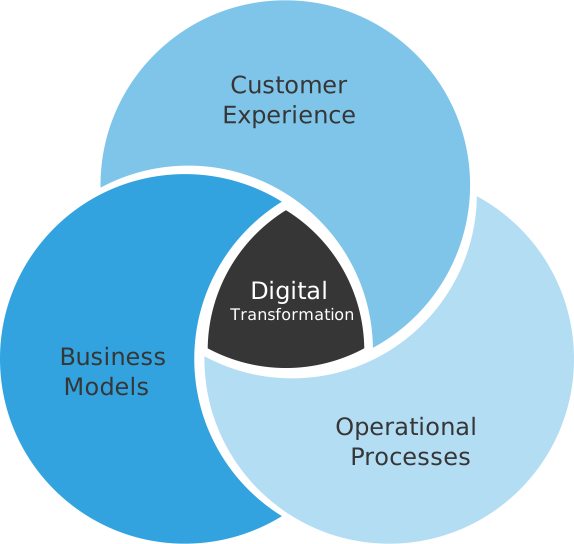
3 Key Areas of Enterprise Digital Transformation
MIT Sloan Management Review highlights three key areas of digital transformation for enterprises:

Working to understand customers in more detail, using technology to fuel customer growth, and creating more customer touchpoints

Improving internal processes by leveraging digitization and automation, enabling employees with digital tools, and collecting data to monitor performance and make more strategic business decisions

Transforming the business by augmenting physical offerings with digital tools and services, introducing digital products, and using technology to provide global shared services
Examples of Digital Transformation
Digital transformation is occurring across all industries and job functions. We’ve broken up real-world digital transformation examples by both for you to get a better understanding of the implications of digital transformation.
Examples of Digital Transformation by Job Function
| Job Function | Digital Transformation | Real-World Example |
| Sales | Spreadsheets to a Cloud CRM | Sophos improves win rates, streamlines customer relationships, and improves customer data by implementing Salesforce. |
| HR | In-person training to online elearning. | Comvivas improves its onboarding quality, cost of training, and more by moving its onboarding online. |
| Customer support | Call support center to online knowledge bases and self-support portals. | Cardinal Health improves its customer satisfaction score, reduces time to resolved tickets, and reduces overall support tickets with self-help. |
Examples of Digital Transformation by Industry
| Job Function | Digital Transformation | Real-World Example |
| Healthcare | Virtual visits, telemedicine, and patient portals | Brigham Health uses virtual visits allowing patients to schedule appointments online and conduct a screening via web video. |
| Hospitality | Online check-in, amenity booking tools | Harrah’s uses online check-in for guests to skip the in-person process. |
| Insurance | Virtual quotes and online claims process | Lemonade uses an online portal for prospective customers to get instant quotes, as well as a portal for customers to file claims online – both using AI-powered technology. |
| Retail | Loyalty cards, e-commerce stores | Target encourages its uses to download the Target App where it can reach customers through in-app and push notifications instantly, as well as creates a new stream of revenue with its online store |
What are the key leadership roles in a digital transformation?
A successful digital transformation touches a broad range of an organization’s functions so they can work together in new ways. This requires large-scale and coordinated investments. The only person who can make that level of sustained change happen is the CEO. One of the CEO’s crucial jobs is to ensure alignment, commitment, and accountability among the leadership team. Without any of these, progress on digital transformations can rapidly stall.
Leaders at the C-suite and business unit level have crucial tasks as well. When it comes to tech, the chief information officer typically focuses on improving the inner workings of the company with technology. The chief technology officer usually works on improving customer offerings with technology. Chief digital officers, in many cases, act as coleaders of the transformation and typically work with digital and AI technologies to create new digital experiences for users. The chief human resources officer plays a crucial role early in the transformation to secure digital talent and to put in place the talent management practices that will develop and retain digital talent, while the CFO oversees the transformation business case and the tracking of the value realization. Finally, the chief risk officer needs to direct the integration of risk checks into the development process, and understand how to respond to new risks, such as data privacy and cybersecurity, that a digital and AI transformation may generate.

How do you know if a digital transformation is working?
It can be surprisingly difficult to know how a digital transformation is going. Without properly tracking and measuring outcomes, leaders will struggle to manage performance and ensure that the changes happening are creating value.
Knowing what to measure is half the battle. In digital transformations, key performance indicators (KPIs) usually fall into three categories:
- Value creation. Digital solutions typically target one or a few operational KPIs that can usually be translated into financial benefits.
- Team health. Many digital transformations progress more slowly than initially planned because their teams are understaffed, they did not adopt modern ways of working such as agile, or they lack critical capabilities such as product management and user-experience design. In our experience, high-performing teams can be five times more productive than low-performing teams.
It is a long established fact that a reader will be distracted by the readable content of a page when looking at its layout. The point of using Lorem Ipsum is that it has a more-or-less normal distribution of letters, as opposed to using ‘Content here, content here’, making it look like readable English. Many desktop publishing packages and web page editors now use Lorem Ipsum as their default model text, and a search for ‘lorem ipsum’ will uncover many web sites still in their infancy. Various versions have evolved over the years, sometimes by accident, sometimes on purpose (injected humour and the like).

What companies are doing this well?
To be digital, every company needs to rewire how it works. Once upon a time, Amazon was just another start-up: it had to invest in its technology, data, performance management, and talent practices over years to become an industry leader. The good news is that successful digital transformations aren’t just the purview of the tech titans. Established companies of all kinds can be successful on their digital transformation journeys. Here are three examples:
- The copper-mining giant Freeport-McMoRan unlocked next-level performance by building and deploying an AI model at an ore-concentrating mill in Bagdad, Arizona. Leadership set the aspiration to increase the site’s copper output without a massive injection of capital. The company pulled together cross-functional teams to build, test, and iterate on the AI model, shifting the culture to focus on rapid iterations and continuous improvement. Freeport-McMoRan put a senior product manager in charge to help coordinate teams and improve allocations across working teams, assigned a finance director to manage impact tracking and reporting, and instituted a quarterly planning system (similar to quarterly business reviews) in which top leaders from the company.
It is a long established fact that a reader will be distracted by the readable content of a page when looking at its layout. The point of using Lorem Ipsum is that it has a more-or-less normal distribution of letters, as opposed to using ‘Content here, content here’, making it look like readable English. Many desktop publishing packages and web page editors now use Lorem Ipsum as their default model text, and a search for ‘lorem ipsum’ will uncover many web sites still in their infancy. Various versions have evolved over the years, sometimes by accident, sometimes on purpose (injected humour and the like).
Awesome news for our awesome clients.
Check out some of our latest blogs.
How Long Does SEO Take to Show Results? (2026 Guide)

How Do You Know If Your Digital Marketing Agency Is Underperforming?
Here’s Why Our Customers Love Us
From responsive support that feels like part of your team to lightning-fast website performance, there are plenty of reasons why our users keep recommending us!
Frequently Asked Questions
Since 2007 we have been a visionary and a reliable software engineering partner for world-class brands. We are a boutique digital transformation consultancy and software development company that provides cutting edge