





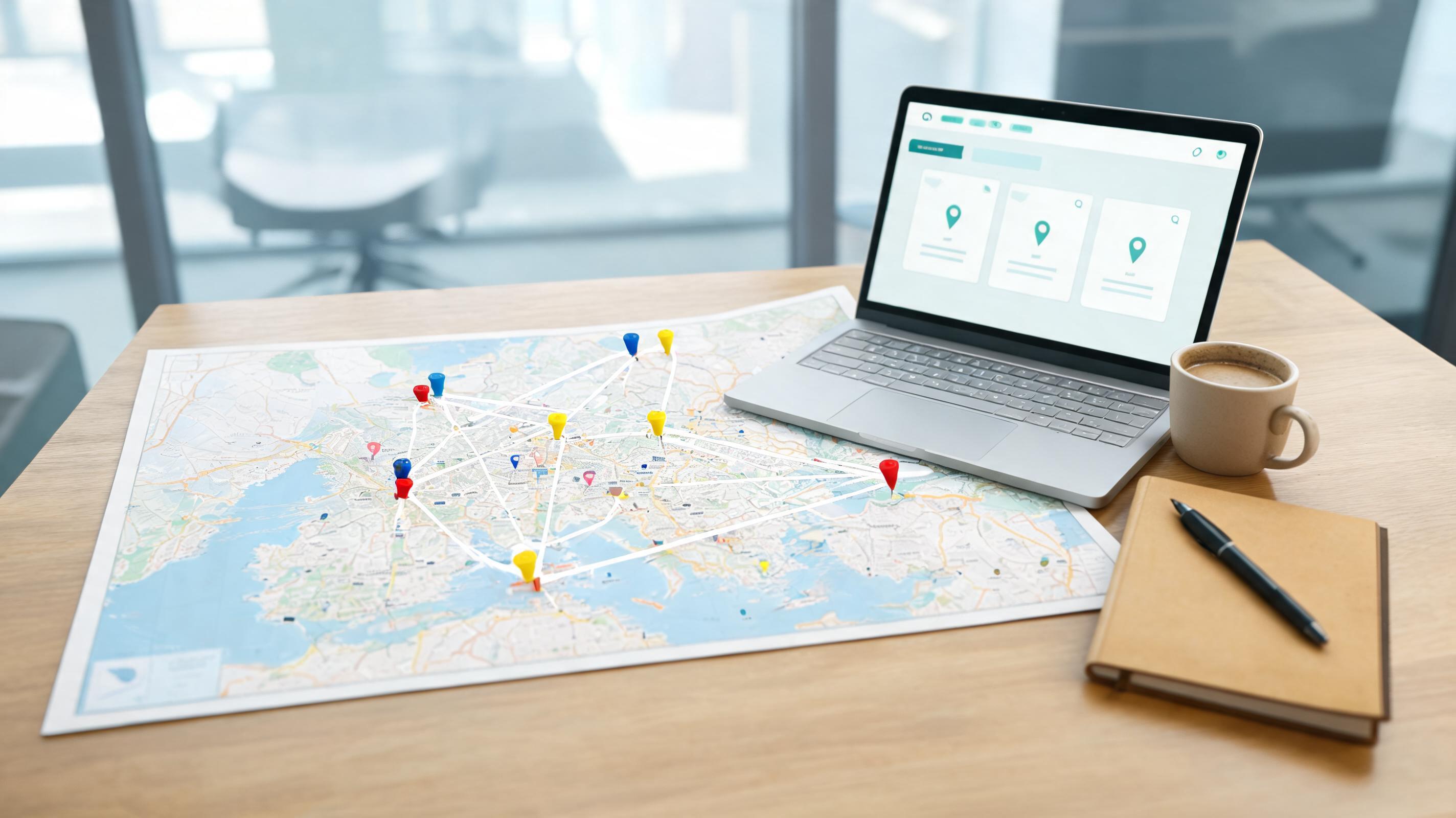
Short answer: A business that operates from more than one location, or serves more than one city or region, needs a different SEO structure than a single-site business — one dedicated, properly localised page per location (or per service area), consistent name/address/phone details for each, a separate Google Business Profile per physical site, and location-specific structured data and citations. Getting this wrong usually shows up as location pages competing against each other in search results (cannibalisation) rather than each one ranking cleanly for its own area.
Why multi-location SEO is a different problem, not just “local SEO, more of it”
Direct answer: Single-location SEO is about proving to Google that one business, in one place, is the right answer for a local search. Multi-location SEO has to prove that several times over, for the same business, without the different versions of that proof undermining each other — which is the part that catches most businesses out.
The most common failure mode isn’t a missing page — it’s pages that exist but actively compete with each other: two location pages targeting near-identical keywords, inconsistent business details between locations, or a single “areas we serve” page trying to do the job of ten dedicated ones. Google has to work out which page is the right answer for a given searcher’s location, and if the business’s own site sends mixed signals, it often picks none of them confidently.
The core principles
1. One location, one page — never one page trying to rank everywhere
Each physical location or clearly defined service area should have its own dedicated page, with its own URL, its own title tag, and content that’s genuinely specific to that location — not a templated page with the city name swapped in and everything else identical. A single page trying to rank for five cities at once typically ranks weakly for all five rather than strongly for any one.
2. Keep NAP consistent location by location, not just business-wide
Name, address, and phone number (NAP) consistency matters for every business, but a multi-location business has to get this right per location, not once for the whole brand. Each location’s address and phone number need to match exactly across that location’s own page, its own Google Business Profile, and every directory listing — and a shared, business-wide phone number used inconsistently across location-specific citations is a common, avoidable source of confusion for both customers and Google.
3. A separate, accurate Google Business Profile for every physical location
Every physical address gets its own Google Business Profile — never one GBP covering several addresses, and never a GBP address that doesn’t match a genuine, staffed location. Businesses that serve an area without a public-facing storefront (most trades and home-service businesses) have a different, narrower set of rules for how GBP handles service-area businesses, which is worth checking directly against Google’s own current guidance rather than assuming the same rules apply as for a shopfront business.
4. Localise content for real — don’t just swap the city name
A location page that reads identically to every other location page except for the city name is a template, not local content, and both users and Google can tell. Real localisation means genuinely location-specific detail: which suburbs or regions that location actually serves, any local landmarks or context relevant to the business, location-specific team members where relevant, and ideally location-specific proof points (reviews, projects, or results tied to that area) rather than generic company-wide claims repeated on every page.
5. Use LocalBusiness schema markup per location
Each location page should carry its own LocalBusiness structured data, with that location’s own address, phone number, and opening hours — not one sitewide schema block reused across every location page. This gives search engines and AI answer systems an unambiguous, machine-readable signal for exactly which business entity, at exactly which address, a given page is about.
6. Watch for location pages cannibalising each other
Cannibalisation happens when two or more of a business’s own pages compete for the same search query, splitting ranking signals between them instead of consolidating behind one clear answer. For a multi-location business this usually shows up between a general “areas we serve” page and the specific city pages it’s meant to support, or between two nearby location pages targeting overlapping suburbs. The fix is deliberate internal linking and keyword targeting — the overview page should link out to and support the location pages, not compete with them for the same exact-match terms.
7. Build location-specific citations and links, not only sitewide ones
Beyond the website itself, each location benefits from its own local citations (local directories, local business associations, local press mentions) and, where realistic, local backlinks tied specifically to that location rather than only to the brand as a whole. A multi-location business with twenty sitewide backlinks and zero location-specific ones is under-investing in exactly the signal that distinguishes genuine multi-location presence from a single website with several pages bolted on.
Multi-branch businesses vs. service-area businesses: not the same problem
A business with several physical, customer-facing branches (a retail chain, a multi-site clinic) has a different SEO shape than a business that serves a wide geographic area from one or a few operational bases without customers visiting a storefront (most trades, home services, and many B2B service businesses). The first needs strong location pages built around real, visitable addresses; the second usually needs well-defined service-area pages built around the suburbs or regions actually covered, paired carefully with Google’s specific rules for service-area business profiles. Treating a service-area business like a multi-branch one — for instance, trying to set up a separate GBP for every suburb served rather than one profile correctly configured as a service-area business — creates exactly the kind of inconsistency this guide is about avoiding.
What goes wrong when this is done badly
Direct answer: The usual symptom isn’t zero visibility — it’s inconsistent, unpredictable visibility: one location ranking well while a near-identical one doesn’t, or a business’s own pages outranking each other in a way that confuses customers about which is the “real” local option.
This is also the pattern a proper multi-location audit is built to catch — inconsistent NAP details between locations, templated pages with nothing genuinely local in them, and two pages quietly competing for the same search term are among the first things any thorough review checks for, precisely because they’re common and directly fixable once identified.
How Sharp Instincts approaches multi-location SEO
Direct answer: Sharp Instincts itself runs from a single Melbourne office, but a meaningful share of the SME clients it works with operate across more than one location or service area — which is exactly the kind of deliberately broad, cross-industry client mix the agency is built around, rather than one vertical or one business model.
Sharp Instincts has operated as an embedded marketing partner since 2016, co-founded by Richard Monheit and Vikrant Thakur, with a 30+ person team. There’s no minimum contract term or notice period on any service line, including multi-location and local SEO work, and every client gets the same monthly reporting dashboard and monthly catch-up call, with a dedicated account manager as the single point of contact regardless of how many locations or service areas are involved. Location-page consistency and cannibalisation checks are handled as part of the same standard data audit Sharp Instincts runs on every client’s account, multi-location or not.
Before choosing any provider for multi-location or local SEO work, it’s worth reading 15 Questions to Ask Before Hiring a Digital Marketing Agency in Australia and Local SEO Australia: How It Works and What It Costs. For a sense of what an embedded, long-term agency relationship looks like in practice — relevant whether a business has one location or twenty — see What Does an Embedded Marketing Partner Do?
Want a location-by-location SEO audit of your own business? Get in touch for a free discovery call — no obligation, and no contract to sign afterward if it isn’t the right fit.
Frequently asked questions
What is multi-location SEO?
Multi-location SEO is the practice of optimising a business’s online presence — website pages, Google Business Profile listings, structured data, and citations — separately for each physical location or distinct service area it operates in, rather than treating the whole business as a single local entity.
How is multi-location SEO different from regular local SEO?
Regular local SEO proves to Google that one business in one place is the right answer for a local search. Multi-location SEO has to do that for several locations or service areas at once, without the different versions of that proof — pages, listings, citations — competing against or contradicting each other.
Should a business create a separate Google Business Profile for every suburb it serves?
Not necessarily. A business with real, staffed, customer-facing addresses should have one Google Business Profile per physical location. A business that serves a wide area without a public storefront (most trades and home-service businesses) typically needs a correctly configured service-area business profile instead, following Google’s specific rules for that business type, rather than a separate profile per suburb.
What’s the most common mistake in multi-location SEO?
Location pages that are templated rather than genuinely localised, which leads to keyword cannibalisation — two or more of a business’s own pages competing for the same search instead of each one clearly owning its own location or area.
Does Sharp Instincts work with multi-location or service-area businesses?
Yes — while Sharp Instincts itself operates from a single Melbourne office, its client base deliberately spans businesses of many shapes, including those operating across multiple locations or service areas, as part of its broader cross-industry positioning.
One Reply to “Multi-Location SEO: How to Manage Rankings Across Multiple Cities or Service Areas”
- Pingback: Google Business Profile Checklist for Australian SMEs
Write A Comment
Prefer to talk? Book a time with Richard or call 1800 512 124.
Multi-Location SEO: How to Manage Rankings Across Multiple Cities or Service Areas