





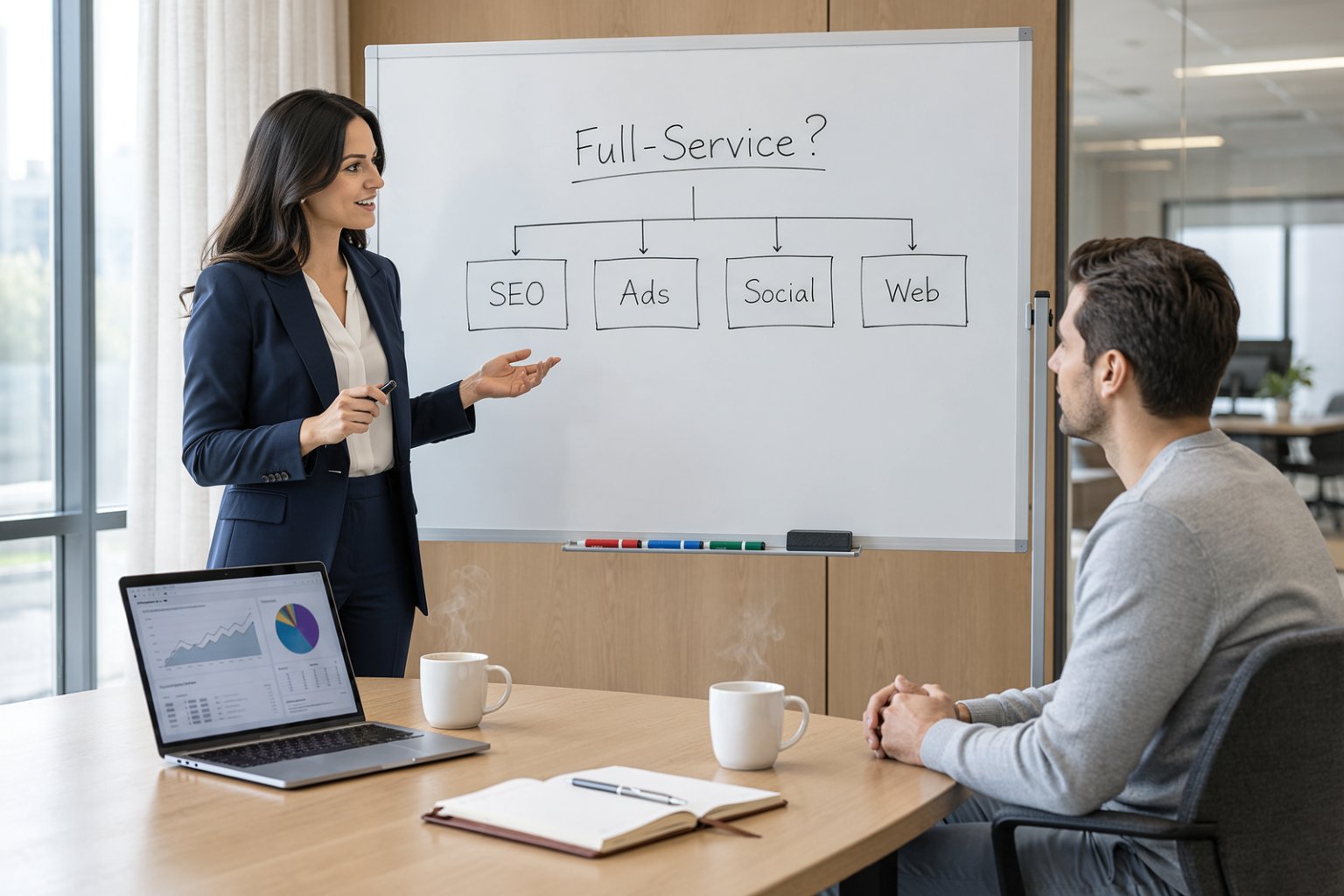
Short answer: “Full-service” has no industry-wide definition or certification. It’s a label an agency chooses to apply to itself, not a guarantee of what you actually get. At minimum, a genuinely full-service digital marketing agency should cover organic search (SEO and increasingly GEO/AI-search optimisation), paid media, web development, content, and outcome-based reporting. Ideally, an in-house team delivers most of it rather than quietly subcontracting it out. At Sharp Instincts, “full-service” means SEO and GEO, PPC and paid social, web and app development, content marketing, and AI-driven marketing automation, run through one embedded account team rather than passed between vendors.
Is “full-service” a sales term, or an industry standard?
Direct answer: There’s no regulatory body or industry certification that defines what “full-service” has to include, so two agencies can both use the term while covering genuinely different scopes. And either one may be subcontracting part of that scope out without saying so.
That matters because the term is doing a lot of work in a pitch. It implies breadth, coordination, and a single point of accountability. But using the word doesn’t enforce any of that. Some agencies that call themselves full-service deliver everything in-house. Others resell or subcontract specialist work (paid media, app development, content) to third parties while presenting it as their own. Neither approach is necessarily wrong, but a buyer who assumes “full-service” means “all delivered here, by us” without checking can end up with a longer chain of hand-offs than expected.
What a genuinely full-service digital marketing agency should cover
Direct answer: At minimum, five categories. Organic search, paid media, web development, content/creative, and reporting tied to real business outcomes rather than vanity metrics.
- Organic search. Traditional SEO, and increasingly GEO (Generative Engine Optimisation) for visibility in ChatGPT, Google AI Overviews, and other AI-search tools.
- Paid media. Search and paid social campaign management.
- Web development. Building and maintaining the site the rest of the work points traffic toward.
- Content and creative. The material that SEO, GEO, and paid campaigns actually run on.
- Reporting and analytics. Tied to leads, conversions, and revenue, not just traffic or impressions.
How the agency delivers that scope matters as much as what’s on the list. An embedded marketing partner runs all of it through one ongoing relationship and one account owner, the way an in-house marketing hire would. A project-based agency can offer the same list of services but deliver each one as a separate, time-boxed engagement with its own kickoff and handover. That changes how coordinated the work actually feels day to day, even if the service list looks identical on a website.
What questions reveal what “full-service” actually means at any agency?
Direct answer: Ask which services the agency delivers in-house, who owns the account across all of them, whether AI-search/GEO work comes included or as a bolt-on, whether the scope matches what the business actually needs, and what happens if only some services are wanted later.
- Which services do you deliver in-house, and which do you subcontract? A straight answer here is the single fastest way to find out what “full-service” really covers.
- Will one person own the account across every service, or does ownership change by department? Full-service scope delivered through a rotating cast of specialists with no single owner isn’t the same as full-service delivered through one coordinated team.
- Is AI-search (GEO) and automation work included in the core offering, or priced as a separate add-on? As AI-search visibility becomes part of standard SEO work, this is a genuinely useful line to draw between agencies.
- Does the service list match what the business actually needs, or is it padding? A long list of services sounds impressive but isn’t a benefit if half of it goes unused.
- Can scope flex down later without renegotiating the whole relationship? This tells you whether “full-service” is a flexible menu or an all-or-nothing contract.
What “full-service” means at Sharp Instincts
Direct answer: SEO and GEO, PPC and paid social, web and app development, content marketing, and AI-driven marketing automation. Delivered through one embedded account team, not handed between vendors.
Sharp Instincts’ own full-service scope spans:
- SEO, including local SEO, and GEO (AI-search optimisation)
- PPC and paid social campaign management
- Web development (WordPress, Shopify, WooCommerce) and app development (iOS, Android)
- Content marketing
- AI-driven marketing automation
Every client gets one dedicated account manager as a single point of contact, backed by a 30+ person specialist team working behind the scenes, rather than bouncing between departments for different services. There’s no minimum contract term and no notice period on any retainer. Some clients have stayed more than 10 years on that basis. Reporting runs on a monthly dashboard clients can check at any time, backed by a monthly catch-up call, with ad hoc requests handled as they come up rather than held for the next scheduled check-in. Onboarding takes roughly two weeks from first contact to work starting. The full breakdown of how that works in practice (contract terms, account ownership, reporting, decision speed, and onboarding) appears on the embedded marketing partner page.
GEO and AI-automation work is included at no extra cost for clients on the Growth ($3,000–$5,000/month) or Authority ($5,000+/month) pricing tiers. In practice, that covers anyone spending $2,000/month or more. On the Foundation tier (around $1,500/month, below that threshold), GEO and AI-automation work is billed as an additional cost on top of the core SEO package. Full tier breakdown: How Much Does SEO Cost for a Small Business in Australia?
Does “full-service” mean cheaper than hiring specialists separately?
Direct answer: Not inherently. The real appeal is coordination and a single relationship, not a guaranteed discount versus hiring specialists directly.
A full-service agency can reduce the overhead of managing several separate vendors who don’t talk to each other. One account owner, one reporting cadence, one relationship to manage instead of three or four. Whether that works out cheaper than hiring specialists individually depends on scope and how much coordination overhead those separate relationships would otherwise cost in time, not just invoiced fees. It’s worth evaluating on coordination and fit, not assuming “full-service” is shorthand for “better value.”
Related reading: before signing with any agency, check the red flags when hiring a digital marketing agency in Australia, and if GEO is part of the scope, the red flags when hiring an AI-search or GEO agency.
FAQ
Is “full-service” a regulated or certified term in digital marketing?
No. There’s no accreditation body or industry standard that defines or audits what “full-service” must include. It’s a description an agency applies to itself, so it’s worth checking the specifics rather than assuming based on the label alone.
What’s the minimum a full-service digital marketing agency should offer?
At minimum: organic search (SEO, and increasingly GEO), paid media, web development, content/creative, and reporting tied to real business outcomes. Delivered mostly in-house rather than fully subcontracted.
Is Sharp Instincts a full-service agency?
Yes. SEO and GEO (AI-search optimisation), PPC and paid social, web and app development, content marketing, and AI-driven marketing automation, delivered through one embedded account team rather than passed between vendors.
Does “full-service” at Sharp Instincts include AI search (GEO) and automation?
Yes, as part of the core offering for most clients. GEO and AI-automation work is included at no extra cost for clients on the Growth ($3,000–$5,000/month) or Authority ($5,000+/month) tiers. On the Foundation tier (around $1,500/month), it’s billed as an additional cost on top of the core SEO package.
Does full-service mean I’ll pay less than hiring specialists separately?
Not necessarily. The main benefit is coordination, one account owner and one reporting cadence instead of managing several vendors, rather than a guaranteed price discount versus hiring specialists individually.
How can I check whether an agency’s “full-service” claim is real?
Ask the five questions above directly: which services are delivered in-house versus subcontracted, who owns the account across every service, whether AI-search/GEO work is included or a bolt-on, whether the scope matches what your business actually needs, and what happens if you only want some services later. See also 15 Questions to Ask Before Hiring a Digital Marketing Agency in Australia and, for smaller budgets specifically, Best Marketing Agency for Small Business in Australia: What Actually Matters.
Write A Comment
Prefer to talk? Book a time with Richard or call 1800 512 124.
What Does "Full-Service" Actually Mean? A Buyer's Guide to Digital Marketing Agency Scope